MacOS

LocalSend - Share files between local devices

Sometimes you need to move files between devices, and it’s often been quite a hassle to just being able to get a file from a Windows machine to an iPad or from Linux to a Mac laptop.

My most common case has often been to move files between MacOS and Android - and while Wifi File Explorer Pro has worked, it’s always seemed a little clumsy. It basically create a webserver on the Android device with a simple but quite usable interface.
Transcoding for local streaming

My home network has a local streaming service based on a local Plex server. It has a few videos wwhich came in odd formats, and where for practical purposes it would be nice to have everything in the same format.

This is my way of transcoding everything to the same format before adding it to the Plex server.

This little script will take all files in the the same directory as the script (given the 4 extentions) and encoding all to Xvid format. The Xvid format is my current prefered format balancing size and quality - and allow for Chromecasting. It may change to a H265 format once all the oldest Chromecast devices are updated and all can handle H265.

Using Bruno with 1Password

Bruno is an open source alternative to tools like Postman or Insomnia. Both are nice, but they also seem to becoming more complicated than I really need, so I’ve been looking for something else.

Initially I didn’t have more complicated needs than wanting a tool to tinker and play with simple REST APIs, so I looked around and found Bruno.

As many APIs require some authentication, you often need to manage credentials, tokens or other sensitive data which shouldn’t be in your git repo, and luckily Bruno has a nice way it can be used with 1Password which is my password manager of choice.

Show wifi password in clear

Got access to a wifi network, but forgot the password? No a problem. At least not if you have a windows, Mac or Linux machine with access. All these OSes can basically without restrictions show you the wifi password in clear text.

Windows

Once you have access to the wifi network. Open the commandline and enter the following command replacing “SSID” with the actual name of the wifi network you want to retrive the password to.

netsh wlan show profile name=SSID key=clear

Automatic MacOS shutdown

From time to time my Mac is doing stuff which takes quite awhile. Converting images, converting videofiles between formats or other stuff, which may take a long time (but reasonable predictable).

In those cases I run a little command in the terminal, to automatically shut down the Mac upon completion:

sudo shutdown -h +120

This command sets a timer which shutdown the machine after two hours (the 120 parameters being after 120 minutes).

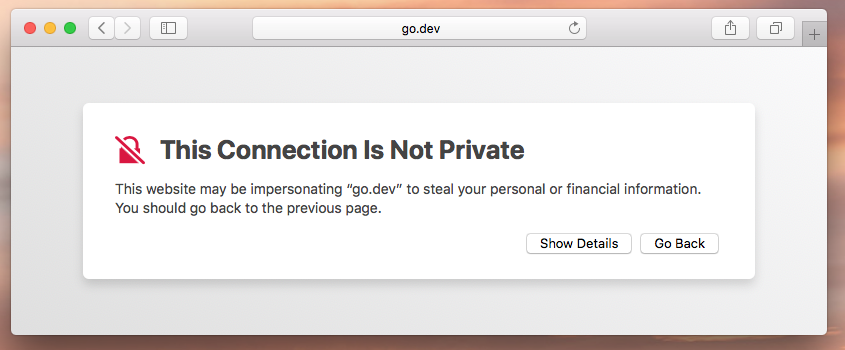
No access to *.dev sites

I’ve been having an odd issue for a couple of months. When accessing sites having a .dev domain (like most recently go.dev), I my browsers have given me warnings and as many had HSTS-headers, not allowed me to visit the site.

It seemed like a strange error, and I’ve tried to remember if I’ve set up some proxy or VPN connection, that could cause this issue. A few times I’ve asked others on the net if they had issues - which was not the case - and I’ve tried using a web proxy, and everything worked. Yet no matter which browser I used it didn’t work.

Baking Audiobooks with m4baker

Building audiobooks on (Debian) Linux in the m4b format is actually possible and doesn’t have to be a pain. I’ve found numerous recipes with shell instructions, but having a nice simple app to handle the building of the books seems much easier.

Most of the apps available for Linux seemed to be in a pre-alpha state, but after a few experiments I’ve settled on m4baker, which - while a bit rough - actually seems to do the job just fine.

Are you ready for transparency?

Running a modern IT platform is rarely an easy nor isolated task. Most platforms consist of a fairly large number of components ranging from OS level to 3. party libraries and components added in the user interfacing layers - and adding numerous integrations does make it an interesting challenge to quickly identify and correct bugs and errors.

While the system complexity does pose a challenge is surely not an impossible task, as several tools exists for most - if not all - platforms to allow instrumentation of the platform and utilize the instrumentation tools to handle the platform and identify issues quickly.

ftp on OSX Lion

While it really isn’t secure at any measure, ftp is a very useful way of moving files around. Apple’s OSX have a build-in basic ftp server, but in Lion (version 10.7) the user interface seems to have disappeared from the User interface. The servers is still available under the hood if you need it.

To enable the ftp-server (the availability) enter this command in a terminal window:

sudo launchctl load -w /System/Library/LaunchDaemons/ftp.plist
From then on use this command to enable the ftp-server:

Salvaging a deleted message from Thunderbird

Suppose you got an important mail, but by accident deleted the message – and to make matters worse, you also decided that emptying the mailbox was a pretty neat idea. Is then time to Panic?

Well it might, but there is a chance you might be able to undelete the message – and quite easily if you’re on a Mac or a Linux machine. Here are the few steps, which has helped recover a lost mail or two… First close Thunderbird. Then located the mail directory (on Linux it’s located in the subdirectory .mozilla-thunderbird in you home directory – on windows most likely somewhere in C:\Documents and Settings*\Application Data\Thunderbird – In there you’re looking for the “Local Folders” directory.